














David J. Bier
Read: Manhattan Institute’s Criticisms Vindicate Cato’s Report on the Fiscal Effect of Immigrants: Part 1
The Manhattan Institute (MI) published a criticism of Cato’s immigration report on the effects of immigrants on government budgets. In Part 1, I explained how MI misrepresented the plausibility of our conclusion and, in so doing, revealed flaws in its own methods that understate the net effect of immigrants on government budgets. Now I will turn to MI’s methodological criticisms, which are bad-faith, irrelevant, and false.
MI declined to share its updated model, so I could not fully compare our two approaches, but for the most part, MI employed the same methods as Cato in its most recent analysis, but fails to inform its readers of this fact.
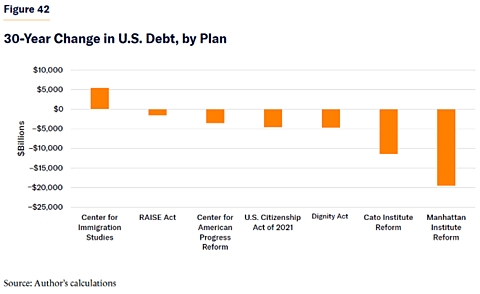
MI concedes the point: immigrants reduce deficits.
MI’s main objection to our study actually has nothing to do with our methodology. Indeed, it has no serious methodological criticisms at all (see below). Instead, it focuses on the presentation of our results. Specifically:
the [Cato] researchers assign the cost of every service received by native-born children of immigrants to the children rather than to the immigrant parents. This removes large expenditures—especially the cost of education—from the fiscal cost of immigration, even though those children would not cost the state anything if their parents had not immigrated.
In other words, MI wants us to—not change our model—but to instead treat US-born children as if they are immigrants. But they are not immigrants, and we wanted to determine whether immigrants are the driver of America’s deficits and debt, or whether Congress needs to reduce spending on US-born Americans—including US-born children of immigrants—to address them.
The fact that some (ha!) US-born Americans are descendants of immigrants does not undermine our thesis at all. Arbitrarily lumping some US-born Americans in with immigrants—without first clearly differentiating the two—would obscure who is driving the fiscal situation in the United States.
Moreover, it is impossible to make accurate comparisons between types of immigrants if all child costs are credited to adults. For instance, is an adult immigrant traveling alone less costly than a child immigrant coming with parents? If the child’s costs are awarded entirely to the parents, we couldn’t use our model to answer this question. Similarly, conflating US-born and immigrant costs confuses policy implications of guest worker programs, immigrant welfare reforms, and deportations. How much do deportations of immigrant adults reduce spending on their US-born children? At a minimum, we can say that it is not 100 percent, as MI claims.
But of course, the US-born children of immigrants exist. They impose costs, and they wouldn’t exist without immigration. They should be analyzed. And you’ll be shocked (if you only read MI’s criticism) to learn that we did estimate the effect of immigrants and their children, finding that they collectively reduced deficits by $7.9 trillion over 30 years. Not only that, but we find that in the long term, the second generation—who are mostly below the age of 20—are already the most fiscally positive at any given age.
We did the very estimates MI demanded. In fact, we overstate these costs by nearly $4 trillion by including the children of immigrants who came in the early 20th century. These early-20th-century immigrants are clearly not the immigrants in our study and do not represent even the indirect costs of post-World War II immigration.
What’s particularly surprising about this criticism is that MI’s 2025 paper essentially uses the same method as the Cato Institute. Like Cato, child benefits—everything from food stamps and Medicaid to education and parks—are credited to children, either US-born or immigrants. Like Cato, it first estimates the effects of immigrants alone and then the effects of immigrants with their descendants, indistinguishable from our report at least in this aspect.
The only difference, as far as I can tell, is that MI treats child tax credits as a cost of adults. This is inconsistent with their treatment of all other types of child benefits, including cash benefits. From our standpoint, a benefit should be credited to the child if the spending would not have occurred without the child’s presence in the United States. Any other method leads to erroneous and misleading results. For instance, if a parent is deported, the value of the child tax credit could increase, since household income would fall. MI does not specify the criteria it uses to decide these questions.
But this issue is tiny compared to the theoretical stance that MI’s critique lays out. Readers get the impression that Di Martino and MI hold a consistent position requiring treating the descendants of immigrants as “immigrants.” But they don’t.
In fact, it is MI, not Cato, that published a 2024 paper by Di Martino that explicitly “excludes the impact of second-generation Americans.” In other words, MI is accusing Cato of doing the very thing that it did.
MI’s methodological objections don’t undermine Cato’s conclusions.
Besides the newly discovered concern about the second generation, MI levels three methodological criticisms relevant to our main analysis that are almost too trivial to address.
The first is:Cato’s [estimates] do not account for the cost of providing public goods—like spending on national defense or roads—and the proportional rise of discretionary spending with population growth. When the U.S. population grows, so does spending on highways and roads, policing, firefighters, and a variety of subsidies.
False. We account for the cost of roads, transportation, policing, fire, and other “public goods” that increase with population growth, and we discuss this issue repeatedly throughout the paper. In fact, our assumption on this point, that costs grow immediately and proportionally in these areas with any increase in the immigrant population, is far more conservative than MI’s own assumption. MI assumes that the growth is more gradual, so MI is criticizing Cato over an issue where Cato adopted a more conservative position than MI did.
We also have a long explanation of why immigration does not increase defense spending. But it doesn’t matter: MI yet again misrepresents its own model on this point, which “exclud[es] defense and other pure public-goods spending completely.”
The second criticism regards nontax revenues, which account for about 6 percent of government revenue and 14 percent of the net positive effect from immigrants. MI is right that the National Academies did not incorporate these government revenues into its model, but it provided no explanation for this exclusion and admitted that it made the deficit seem worse than it was. Nonetheless, MI comments:In the study’s estimates, such revenues account for more than one third of the net payments attributed to low-skilled immigrants. Yet there is little reason to assume that low-income immigrants are generating thousands of dollars per person for government enterprises.
First, MI also employs a subtle rhetorical shift from “low-skilled” to “low-income,” when these categories aren’t the same. You can have low educational attainment and be high income or vice versa. More importantly, MI is confused about what these revenues are. They have little to do with government enterprises, though immigrants are consumers who contribute to their profits. They include a wide range of revenue sources, including leases or rental income from government property, but the biggest amount comes from fees and fines, largely related to vehicles, licenses, and the like, which are notoriously regressive.
While MI claims to find our numbers implausible, the fact is that these revenues exist. For fees and revenues from businesses, we attributed them to shareholders’ dividend income. For state and local fines and fees unrelated to businesses, such as vehicle fees and revenue from violations, we attributed them based on sales tax revenue. This was a conservative assumption since flat fees are more regressive than sales taxes. MI never offers any argument for why Cato should not have modeled them at all, nor does it give any reason that a different modeling choice would have significantly changed our results.
The third criticism is technical and also irrelevant to our main conclusion. MI states:On the revenue side, the study assigns 30 percent of corporate tax revenues to immigrant workers—more than prior analyses—while simultaneously assuming income, payroll, and sales taxes are exclusively borne by workers. But if corporate taxes are partially borne by immigrant workers, then other taxes should only be partially borne by native employers as well. The methodology therefore maximizes the revenues attributed to immigrants while minimizing the attributed costs.
There is indeed a minor tension in our analysis here, but not in the way MI presents at all. In a fiscal analysis like ours, we aren’t trying to identify who specifically sent the money to the government. We are trying to track which individuals are ultimately responsible for the growth in revenue. We assume (as does the National Academies) that when an immigrant comes, the fact that sales taxes are paid by a business isn’t relevant. The taxes wouldn’t be paid without the immigrant consumers. The same principle applies to payroll taxes. No immigrant workers on payroll, no more payroll taxes. MI has the same approach.
MI accuses us of being inconsistent in our analysis of the corporate income tax. Instead of attributing all the profits generated by the corporation from employing the immigrant, the National Academies assigns 20 percent to the worker and 80 percent to the shareholders. For our part, we decided to follow the more recent research on “tax incidence,” which finds that more than 70 percent of corporate tax increases are borne by workers’ wages.
MI is right: that is inconsistent. Economist Michael Clemens has written a paper arguing that the National Academies got this wrong and should have attributed 100 percent of corporate income taxes to workers, because whether the tax comes out of profits or wages is irrelevant, since the profits wouldn’t exist at all without the immigrant workers. In other words, MI is right, but the consistent position would have increased the amount attributed to immigrant workers. MI has a different method that indirectly accounts for future growth in capital, which, as far as I can tell without actual access to the model, is Clemens’ approach. In other words, yet again, MI is criticizing Cato for methods that were more conservative than its own.
Regardless, since many immigrants are business owners, this issue is irrelevant to our aggregate conclusion for all immigrants. While it matters more in the analysis of the effects of different types of immigrants, sticking with the original 20–80 distribution would reduce the net effect for all immigrants by less than 1 percent (Table A3).
MI ignores all the ways in which Cato inflates the costs of immigrants.
MI claims that Cato is biased:
Its conclusion rests on accounting assumptions that inflate immigrant tax payments, underestimate costs, and attribute fiscal effects to immigrants in ways that systematically favor immigrants.
Despite this bold claim, MI identifies no ways in which we did this—literally none. The issue about corporate tax revenue is revealing because it demonstrates the lengths to which MI went to ignore all the ways in which our methods lead to a more conservative result than is warranted. Here are a few other examples:
Again, we assume that shareholders pay 30 percent of the cost of the corporate income tax, rather than 100 percent as suggested by economist Michael Clemens and Di Martino’s model. Again, we assumed that all congestible public goods spending—everything from parks and roads to fire protection and most law enforcement—increases immediately and proportionally with any increase in the population from immigration. This is obviously severely overstated, so much so that MI’s 2025 study doesn’t adopt it. MI should know that we didn’t use every means to favor immigrants. Why not criticize us for that? Instead, MI claims we didn’t even account for road costs at all, which is obviously false. We mention accounting for transportation spending seven times in the report. We likewise assumed that public education spending increases immediately and proportionally with any increase in the population from immigration. Again, this is overstated and not adopted by, for instance, the CBO. We followed the National Academies in using the highest available estimate of the cost of bilingual education, based on an ancient (1991) estimate from one state (Florida) that vastly exceeds any recent estimates. We attributed all non-tax government revenues from businesses entirely to the business owners, not to the workers. This is unfair. If the business had no workers, it couldn’t operate. At least a portion of these revenues should be attributed to immigrant workers. We followed the National Academies’ assumption that immigrants cause a proportional share of Border Patrol spending, such that current immigrants are deemed to cause spending intended to prevent future immigrants from coming. Is that fair? Again, when we calculated the cost of children of immigrants, we included children of immigrants who were not themselves immigrants in our study—that is, they were the children of immigrants who arrived in the early 20th century. When people dispute our findings about recent immigrants, they want to know the effects of recent immigrants’ children. If we had excluded these elderly retirees, the fiscal benefit from immigrants with their children would have risen by nearly $4 trillion. We ignored all the ways in which immigrants increase the productivity of US-born workers, which increases their incomes and tax payments. In 2024, the CBO estimated that newly arrived illegal immigrants, asylum seekers, and their families would reduce the federal deficit by between $700 and $900 billion over 10 years, and of this amount, 45 to 55 percent would come from increasing the productivity of US workers. Mark Colas and Dominik Sachs have shown that even using the most conservative estimate of how much low-skilled immigrants affect the wages of US workers would increase their fiscal effect beyond what we find. MI should know all this because we wrote about these issues in our paper, but also because Di Martino wrote about the CBO report.Conclusion
MI states:
The result of Cato’s unrealistic assumptions is a conclusion that every additional resident—regardless of income or education—is a large fiscal asset in a country running persistent trillion-dollar deficits.
We never make such an absurd statement. There are certainly immigrants who exacerbate the country’s fiscal challenges. Unemployed immigrants, children, and most retirees are fiscal drags, but our analysis shows that these immigrants are far from the norm. The average immigrant—even the average low-skilled immigrants—improve the fiscal situation of the United States, but that’s far from the misleading claim that MI makes.
After MI published its first fiscal effects paper in 2024, we carefully analyzed it and published a response. We found numerous problems that rendered the results invalid. MI published another paper last year that “fixes several assumptions from previous research on the fiscal impact of immigrants,” which we suggested, but as I indicated, has many other problems. MI would not share its model to fully replicate that version. Nonetheless, MI cites its earlier, 2024 paper as refuting our work—even though it changed its methods in response to our criticism.
Rather than crowing about these changes, I offered to work with MI’s Di Martino to identify any actual problems with Cato’s model. He never did. If he ever does, it is unlikely to affect the robustness of our conclusion: immigrants reduced the deficits by trillions.