








Patrick G. Eddington
On his first day in office for his second term as president, Donald Trump issued a slew of executive orders and proclamations. One proclamation declared a “national emergency” on the US-Mexico border. In that proclamation, Trump directed the Defense Department to “support the activities of the Secretary of Homeland Security in obtaining complete operational control of the southern border of the United States.” He also directed that within 90 days of the proclamation (April 20, 2025), the Defense and Homeland Security departments were to “submit a joint report to the President about the conditions at the southern border of the United States and any recommendations regarding additional actions that may be necessary to obtain complete operational control of the southern border, including whether to invoke the Insurrection Act of 1807.”
One week later, US Northern Command (NORTHCOM) began a planning process that culminated with representatives from other military commands and the Department of Homeland Security conducting a classified wargame on February 25–26, 2025, originally designated SECRET/NOFORN and named CONPLAN 3900 TITUS—Territorial Integrity of the United States.
A feature of the exercise was exploring various options for the potential use of military forces for domestic law enforcement, including the “Limited suspension of Posse Comitatus,” according to a partially declassified NORTHCOM slide deck obtained through a May 2025 Freedom of Information Act (FOIA) lawsuit brought by the Cato Institute. The records cited herein were not released until July 2026.
The Posse Comitatus Act, codified at 18 U.S.C. § 1385, only permits the use of military forces to “execute the laws” domestically “in cases and under circumstances expressly authorized by the Constitution or Act of Congress.” One of the laws passed by Congress that could be used to bypass the Posse Comitatus Act’s restrictions is the Insurrection Act. Two slides provide clues that the Insurrection Act invocation issue was part of the wargame. The first slide, “Restated Mission and Intent,” revealed that NORTHCOM elements “BPT [be prepared to] assume the role of Lead Federal Agency for border control operations.”
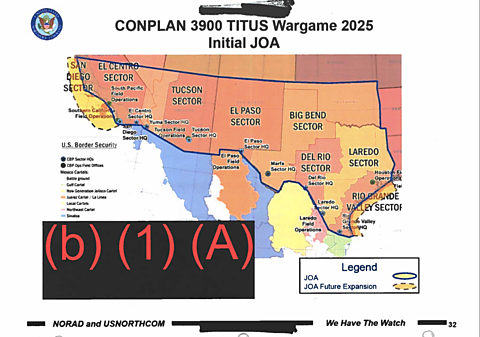
A Trump decision to have NORTHCOM take over border security operations outside of DoD-controlled property (more on this below)—to include domestic law enforcement activities—would almost certainly require invoking the Insurrection Act, a fact that the wargame planners and participants clearly recognized, as the circled portion on the following slide reveals:
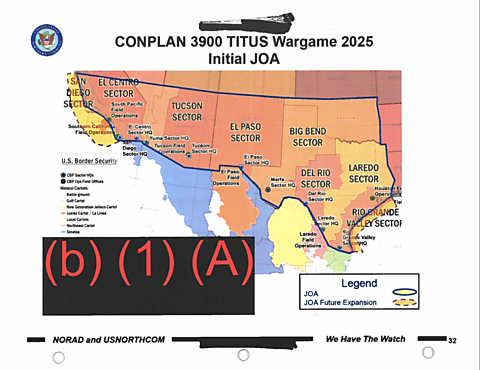
Of note is that the second phase of the “border security” operation in the wargame did not involve the southern border alone but also encompassed all or most of the interiors of the states of Oklahoma, Texas, New Mexico, Arizona, California and its Pacific coast, and southern Nevada, as the following slide demonstrates:
The wargame also envisioned an active US military presence on Mexican soil, with US military forces advising and even conducting joint military operations with Mexican Special Operations Forces (MEXSOF) against drug cartels.
A NORTHCOM post-wargame calendar featured a timeline for getting the results of the wargame and related recommendations to the Secretary of Defense and the Joint Chiefs of Staff no later than March 20, 2025:
Whether Defense Secretary Pete Hegseth accepted or modified NORTHCOM’s recommendations is not public at this time. What is clear is that key military deployment actions exercised during the wargame were operationally implemented in its aftermath. In retrospect, it appears that CONPLAN 3900 served as the de facto blueprint for President Trump’s unprecedented domestic militarization program, starting with the immigration enforcement mission.
On March 25, 2025, the US Army announced that the establishment of Joint Task Force-Southern Border (JTF-SB) had occurred on March 14, 2025. Members of JTF-SB were participants in the CONPLAN 3900 TITUS wargame held just one month earlier.
Between mid-March and early June 2025, thousands of military personnel were deployed to the US-Mexico border region, most of them active-duty Army units that were employed in so-called National Defense Areas (NDAs), where troops were authorized to detain persons attempting to cross the border. The designation of NDAs along the border represented an attempted legal side-stepping of the Posse Comitatus Act that may have been one of the “expanded authorities and permissions” wargamed under CONPLAN 3900. The use of NDA’s in the border security context has also been a subject of litigation.
Moreover, those NDA’s only encompass a fraction of the US-Mexico border. Getting other uniformed troops deployed along the rest of the border or otherwise involved in support of CBP and ICE elements in the interior of the US would require a different legal authority. Trump tested one of those military mobilization legal authorities by calling up other troops for immigration enforcement operations—over the objection of the governors of targeted states, after the NORTHCOM wargame.
On June 7, 2025, Trump issued a memo ordering, under 10 U.S.C. § 12406, the call-up of thousands of National Guard (NG) troops in support of Immigration and Customs Enforcement (ICE) raids and other activities in California (and later in several other states). However, Trump’s use of that Title 10 authority resulted in multiple lawsuits challenging his basis for invoking the statute, and in December 2025, the Supreme Court at least temporarily took that legal option off the table. Even so, NORTHCOM clearly executed CONPLAN 3900 or some variant of it, given the military’s on-the-ground support of ICE and other DHS elements in 2025.
There is also reason to believe that another Trump-directed initiative is designed to meet any mass political protests with a domestic military response.
On August 25, 2025, Trump issued Executive Order 14339, “Additional Measures To Address the Crime Emergency in the District of Columbia.” The order radically expanded the role of the DC NG in response to Trump’s prior invocation of a “crime emergency” in the District of Columbia—a claim I’ve previously debunked.
Trump’s order directed Defense Secretary Hegseth to “immediately create and begin training, manning, hiring, and equipping a specialized unit within the District of Columbia National Guard … that is dedicated to ensuring public safety and order in the Nation’s capital” and further directed that DoD, DHS, and DoJ “shall each deputize the members of this unit to enforce Federal law.”
That unit, the “260th Special Purpose Brigade,” became operational on March 7, 2026.
Standing up one permanent, specialized DC-based NG unit for “civil unrest” deployments is, to the best of the author’s knowledge, unprecedented. But Trump’s order directed Hegseth to go much farther.
Under Trump’s order, Hegseth was to ensure “that each State’s Army National Guard and Air National Guard are resourced, trained, organized, and available to assist Federal, State, and local law enforcement in quelling civil disturbances and ensuring the public safety and order” and to create “a standing National Guard quick reaction force that shall be resourced, trained, and available for rapid nationwide deployment.”
In October 2025, the National Guard Bureau (NGB)—one of the Pentagon components that participated in the NORTHCOM CONPLAN 3900 wargame—issued formal implementation instructions to all state NGs directing the creation and fielding of 500-person quick reaction force (QRF) units—more than 20,000 armed and armored troops.
The episodic call-up of NG units to respond to high-profile domestic events over the last 60+ years (enforcing civil rights laws, assisting with natural disaster recovery, etc.) is nothing new. What is new and decidedly ominous is the creation of specific, permanent military units designed and equipped to directly confront citizens engaged in unspecified, currently nonexistent “civil disturbances.”
That the deployment of DC and other state National Guard units in the nation’s capital has been extended through January 20, 2029—a period spanning two federal elections—is particularly alarming.
In December 2020, Trump prepared but never issued an executive order directing the Defense Department to seize voting machines as part of his attack on the legitimacy of the 2020 election, which he lost.
Since his return to the presidency in January 2025, Trump has continued to make evidence-free claims that America’s election system is rife with voter fraud or otherwise vulnerable to manipulation by hostile foreign actors and, in early 2025, directed then-Director of National Intelligence (DNI) Tulsi Gabbard to investigate voting machines used by Puerto Rico—despite a lack of evidence that any of the machines had been compromised by a hostile entity.
Trump’s proclivity to use national security-related elements in connection with election matters, along with these recent developments, raises frightening questions.
Has NORTHCOM wargamed “election integrity” operations? Is Trump planning on invoking the Insurrection Act in relation to the 2026 midterms? Is that why Trump needs a 20,000+ strong standing, domestic military force with a “civil unrest” response mission?
A Congress dedicated to actual oversight of the executive branch and the protection of constitutional rights would’ve been asking these questions, holding hearings, and demanding answers months ago.