










Adam N. Michel
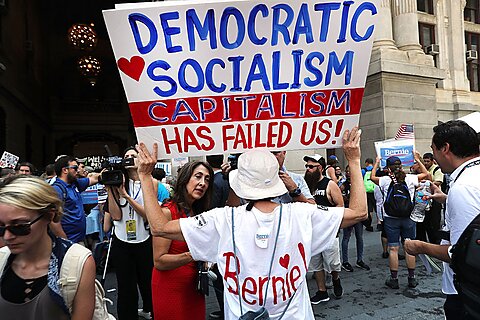
The Democratic Socialists of America (DSA) propose new spending that could more than triple federal outlays. They propose the government pay for health care, housing, higher education, and electricity. Jobs are government-guaranteed, retirement benefits are expanded, paid family leave is universal, fossil fuels are eliminated, and reparations are paid.
The DSA platform claims that the bill for all this will be sent to “the richest individuals and corporations.” Tally up that bill, and it ballparks between $71 trillion and $212 trillion in new spending over the next decade. Confiscating every dollar of high-end wealth and corporate profits would cover only a fraction of those costs. The DSA agenda necessitates high taxes on middle-class Americans.
$200 Trillion in New Spending
Totaling up nine of the largest proposals in the DSA platform would mean new federal spending equivalent to between 18 percent and 53 percent of GDP.
Table 1 reports various low-end and high-end estimates of proposals for programs that approximate the DSA’s vague descriptions. Each proposal’s original spending estimate is converted to a share of GDP and then applied to the 2027–2036 projected GDP, so all estimates are in current dollars.
Medicare-for-All-style proposals for universal healthcare would increase federal spending by $40 trillion to $75 trillion over 10 years. Reparations, a federal jobs guarantee, infrastructure, green energy investment, larger retirement benefits, free housing, paid family leave, and no-cost college would increase spending by tens of trillions of dollars more. In total, the DSA’s new spending would cost between $71 trillion and $212 trillion over the next decade.
This exercise is inherently imperfect, which is why the estimates vary so widely and should be understood as orders-of-magnitude estimates. They likely overstate the cost where programs overlap with each other or existing spending. They understate the cost by failing to fully capture behavioral responses, broader economic effects, and the comprehensive scope contemplated by the DSA. Each estimate comes from different authors using different methods and assumptions, and builds on a similar methodology by David Burton.
Internationally High Spending
In the US, federal, state, and local governments spent almost 40 percent of GDP in 2024. The average across the European Union is 49 percent, ranging from 58 percent in Finland to 22 percent in Ireland.
Using the lower-bound estimates, the DSA agenda would raise US spending to more than 57 percent of GDP. Among large, industrialized countries, only Finland would have a larger government. France comes in a third of a percentage point under the US’s low estimate. Add the high-end estimates, and US government spending would reach 92 percent of GDP.
No comparable country on Earth spends anywhere close to that amount. The DSA agenda’s spending could give the government a claim on national output much closer to estimates of state control under Soviet-style communism than to today’s European welfare states.
Who Pays?
The federal government is projected to collect $70 trillion in taxes over the next decade, roughly 18 percent of GDP. Paying for the DSA agenda would require roughly doubling federal revenue at the low end and quadrupling it at the high end, in addition to the revenue needed to cover the Congressional Budget Office’s $24 trillion projected ten-year deficit.
The DSA suggests that the richest Americans and corporations will pay for all these new outlays. The problem is, there simply aren’t enough resources at the top to make this plan work.
The 400 wealthiest Americans were worth a record $6.6 trillion in 2025. Confiscating all of their wealth would cover only about 9 percent of the low-end revenue requirement and 3 percent of the high-end estimate. Their wealth could be seized only once, and attempting to liquidate trillions of dollars in assets would, in turn, drive their value down.
Domestic corporate profits after federal taxes are projected to be about $35 trillion over the next decade. Seizing every additional dollar of corporate profits would fund half of the low-end estimate and 17 percent of the high end. This also assumes that firms continue operating normally while the government takes every cent of profit. Without a profit motive, businesses would cease to exist.
Higher earners are also not a source of vast untapped revenue. A recent report by economists at the Joint Committee on Taxation concluded that raising top federal income tax rates to their revenue-maximizing level would result in revenue gains of less than 0.1 percent of GDP, equivalent to roughly $400 billion over a decade at today’s projected GDP levels.
The entire wealth of the richest Americans, plus every dollar of corporate profit and maximum top income tax rates, still leaves the DSA agenda between $29 trillion and $169 trillion short.
The only remaining source of revenue large enough to cover the DSA agenda is the same one every large European welfare state relies on: the middle class. France and Finland don’t fund their large governments by only taxing billionaires. They impose high income, payroll, and consumption taxes on ordinary households.
To cover the DSA’s high-end spending estimate and current deficits, every $1 the federal government collects today would need to become about $4.36. Mechanically applying that increase to individual income-tax rates would push the 24 percent bracket above 100 percent and the top rate above 160 percent.
The DSA is promising Americans a world in which someone else will pay for potentially hundreds of trillions of dollars in new benefits. The problem is that there aren’t enough rich people or corporations to pay for Democratic Socialism. Eventually, the bill will come for the rest of us.