














Mustafa Akyol
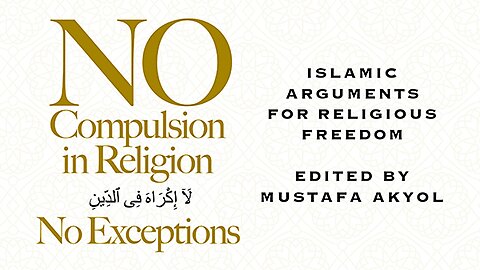
The Journal of Islamic Studies, a publication of Oxford University on behalf of the Oxford Centre for Islamic Studies, published a laudatory review of the Cato Institute book, No Compulsion in Religion—No Exceptions: Islamic Arguments for Religious Freedom. Written by Jacob Williams, a political theorist at Princeton University’s James Madison Program, the five-page review evaluated not just the book’s arguments but also its place in the intellectual landscape about Islam today.
Williams first correctly captured why this book was needed in the first place:
The Qurʾānic declaration against ‘compulsion in religion’ (Q. 2:256) has become the symbolic locus of debates about freedom of conscience and worship in Islam, both inside and outside the Muslim world. Classical jurisprudence, as is widely known, interpreted this injunction against compulsion as applying to forced conversions of non-Muslims but not to compelling Muslims to refrain from apostasy, blasphemy, or backsliding in practice. Attempts to reconcile the forms of compulsion that classical jurisprudence permitted with modern doctrines of human rights are not persuasive, since the rights to change one’s religion, or to practise or not practise a religion according to one’s conscience, are central to the conception of human dignity on which modern human rights doctrine is based.
But should Muslims really take “modern human rights doctrine” seriously? This is a seriously debated question, even in Western academia, in part because some “post-colonial” narratives have not only challenged the wrongdoings of Western colonialism but have gone as far as dismissing liberalism and democracy as “epistemic” tools of the colonial project. (An argument that, ironically, can become an epistemic tool of non-Western autocrats and illiberals.) Being cognizant of this background, Williams perceptively writes:
Does framing the issue in this way involve an epistemic injustice, an imperialistic subordination of the Islamic tradition to Western standards of freedom? Perhaps. But whether this is so depends on whether modern human rights doctrines are right. If the claim that human dignity requires respect for the modern panoply of religious liberties is true, the strong version of the postcolonial critique fails. However, a weaker post-colonial claim—along the lines that Muslims should work towards respecting religious liberty without undue external pressure and in a manner congruent with the resources of their own intellectual heritage—remains perfectly sound. Mustafa Akyol’s new edited volume accepts the weak postcolonial claim while rejecting the strong one. The book does not beg the question in favour of modern views of religious freedom; it seeks to justify them on the basis of the Islamic tradition itself.
That is indeed what No Compulsion in Religion—No Exceptions has aimed to do: Exploring and elucidating specifically Islamic arguments for religious freedom. Williams gets that right as well. He also frames it in an interesting way: libertarian in philosophy; “Leninist” (!) in practicality:
The volume successfully performs the difficult balancing act of remaining academically grounded while demanding action-guiding relevance to live political debates of the present day. If the answers Akyol prefers lean libertarian, the implicit question of the book—what is to be done?—is resolutely Leninist. As such, the volume’s chapters directly engage the most fiercely controversial questions about religious freedom and Islam: apostasy and blasphemy, Ramadan laws, gender equality, and the role of religion in the Iranian regime.
The review then goes through the book’s chapters, summarizing their arguments, as well as engaging with some methodological perspectives that I discussed in this book or elsewhere. His conclusion is worth quoting in full:
Akyol’s volume makes an important and much needed contribution to the debate about Islam and religious liberty. As is inevitable for a volume of this breadth, experts in the specific topics addressed will likely find aspects of the respective chapters to quibble with. This does not, however, undermine the overall force of the volume’s argument. Those who defend exceptions to the Islamic stricture against compulsion in religion must meet the burden of responding to this volume’s arguments.
The review is available here, though behind a paywall. Thanks to Williams and the editors of the Journal of Islamic Studies for publishing it.