











Thomas A. Berry and Dan Greenberg
Majestic Realty and its partners own and operate two adjoining open-air shopping centers in Redlands, California. These shopping centers prohibit any soliciting, petitioning, polling for political causes, or distribution of pamphlets on their private property. Alex Salazar, a “men’s rights” activist, nonetheless sought permission to distribute flyers on the centers’ private property. He was denied that permission, and he then sued the centers in the California state court. The California State Court of Appeals ruled in favor of Salazar, holding that the centers’ ban on distributing flyers violated the California Supreme Court’s decision in Robins v. PruneYard Shopping Center (1979).
In Pruneyard, the California Supreme Court held that the free speech provisions of the California Constitution “protect speech and petitioning, reasonably exercised, in shopping centers even when the centers are privately owned.” That decision was then appealed to the US Supreme Court, which held that this newly adopted California rule did not violate the rights of private property owners under the US Constitution. The US Supreme Court rejected a shopping center’s claim that being forced to host speakers violated both its First Amendment speech rights and its Fifth Amendment property rights.
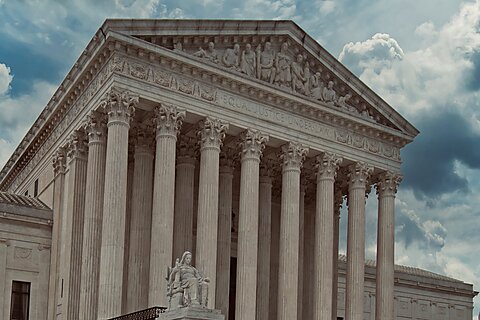
Now, Majestic Realty has asked the US Supreme Court to take its case and overrule the PruneYard precedent, and Cato filed an amicus brief in support of that petition. Today, the Supreme Court will meet and consider whether to grant that petition.
In our brief, we argue that the Supreme Court should take this case because PruneYard was wrong on the day it was decided. Although PruneYard was wrong in both its First Amendment and Fifth Amendment analysis, our brief focuses on why compelled hosting of others’ speech violates the First Amendment.
PruneYard held that property owners suffer no First Amendment injury so long as they have a means of disassociating themselves from the views they are forced to host. But that reasoning is incompatible with two prior Supreme Court decisions: Wooley v. Maynard (1977) and Abood v. Detroit Board of Education (1977).
Wooley held that drivers may not be compelled to host unwanted slogans on their license plates, and Abood held that union members may not be compelled to fund unwanted political speech with their own money. In both cases, the Court explained that compelled platforming of speech violates the First Amendment, even when the compelled speech would not be mistaken for the platform owner’s own beliefs. And since 1980, PruneYard’s status as a First Amendment aberration has only grown starker.
The Supreme Court recently held that social media websites may not be compelled to host speech they do not want in Moody v. NetChoice (2024). Much of the reasoning of that decision further undermined PruneYard, explicitly rejecting its focus on whether an owner would be falsely believed to endorse hosted speech.
The Supreme Court should take this case, overrule PruneYard, and hold that California’s rule violates the First Amendment right of private property owners against the compelled platforming of speech.