














Colin Grabow
A new Congressional Research Service (CRS) report contains a startling fact: it’s cheaper to ship phosphate rock to Louisiana from Peru (~2,300 nautical miles away) than Florida (~500 nautical miles). And it’s not even close. According to an official with phosphate producer Mosaic, the Peru route is almost half the cost of shipping from Florida despite its much longer distance and Panama Canal fees.
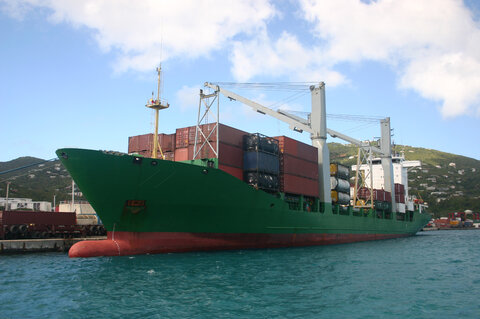
The reason for this disparity is the Jones Act, a federal law that restricts the transportation of goods between US ports to vessels that are US-flagged, US-built, and US-owned. Those vessels cost roughly four times as much to operate as foreign-flagged ships and four to five times as much to build. And sometimes the ships simply don’t even exist. As the CRS report points out, the most cost-effective vessel for moving phosphate rock is a dry bulk ship. But of the thousands of such ships in the world, not a single one complies with the Jones Act.
Together, these factors result in shipping costs so high that it can make more financial sense for Americans to import a fertilizer ingredient from another continent than to purchase it from another state.
The Peru example isn’t an outlier. At a 2021 US International Trade Commission (USITC) hearing, Mosaic testified that it cost as much to ship fertilizer from Florida to Louisiana as to Brazil. That’s the same $18-per-ton price despite Brazil’s ports being six to ten times farther from Tampa than New Orleans (Itaqui about six times, Santos and Paranaguá about ten).
Urea ammonium nitrate (UAN, a liquid fertilizer) follows the same pattern. At a June 2022 USITC hearing, the CEO of Helm Fertilizer Corporation testified that the company’s Stockton, California, terminal could import UAN from Trinidad and Tobago at a “considerable freight advantage, at least $20 per ton” compared to either rail or Jones Act-compliant shipping from domestic sources. That comports with a 2021 USITC preliminary conference at which the president of International Raw Materials Ltd described the seaborne delivery of domestic fertilizer to the West Coast as “economically prohibitive.”
The East Coast is not spared. Such are the costs of Jones Act shipping that the CRS report notes the ports of Baltimore, Norfolk, and Wilmington import nitrogen fertilizer from Trinidad and Tobago, Algeria, and even Russia rather than from Baton Rouge or New Orleans.
Once again, a lack of suitable ships is a contributing factor. Ammonia can be transported on LPG (liquefied petroleum gas) tankers, but none exist in the Jones Act fleet. UAN typically moves by chemical tanker, and the Jones Act fleet lacks the small chemical tankers this trade can require.
And these missing vessels are unlikely to ever appear. Because Jones Act ships are too costly to compete in international shipping, they must earn their keep purely within the US market. If there isn’t sufficient volume of business to keep them fully employed — occasional cargoes won’t suffice — they will not be built or operated. As CRS puts it, “seasonal products requiring a few ship voyages per year, such as fertilizers, may be problematic markets for Jones Act carriers to serve.”
The current Jones Act waiver illustrates the consequences. Since its March announcement — following requests from both the American Farm Bureau and the Fertilizer Institute — a dozen voyages of fertilizer and related inputs on foreign vessels have taken place. All involved were either LPG tankers (9), dry bulk ships (2), or a small chemical tanker, none of which are found in the Jones Act fleet. When appropriate ships for the job presented themselves, demand materialized.
The evidence is clear that the Jones Act makes it more expensive, and sometimes impossible, to move American fertilizer and its ingredients to domestic customers by sea. At a minimum, the law should be changed to allow others to do the job that US shipping firms either can’t or won’t.