










Nicholas Anthony
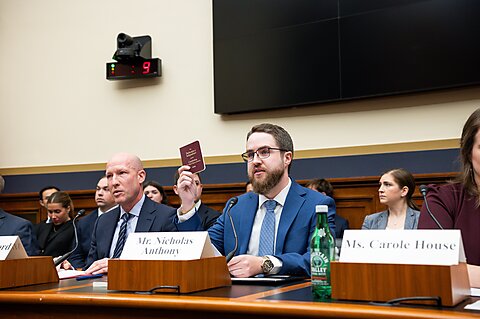
Following my testimony before the House Committee on Financial Services, I want to share what I said during my opening remarks. For my full written testimony, see here.
The Fourth Amendment to the US Constitution says,
The right of the people to be secure in their persons, houses, papers, and effects, against unreasonable searches and seizures, shall not be violated.
Everyone in this room knows this, but it bears repeating because there are too many problems with the Bank Secrecy Act for me to describe all of them in just five minutes.
There’s inflationary surveillance, transnational repression, a lack of oversight, shifting goalposts, and much more.
Frankly, I even take issue with the fact that “FBAR” is an abbreviation that stands for “report on foreign bank and financial account.” But I don’t have enough time to cover every issue and will therefore leave many comments to my written testimony.
A Broken System
Instead, I want to leave you with three numbers: 59 billion, 28 million, and 275.
In a single year, US financial institutions spend an estimated $59 billion complying with the Bank Secrecy Act. That regime forced them to file 28 million reports on their customers. And yet those reports only tipped off 275 investigations by the IRS.
$59 billion in compliance costs. 28 million privacy violations. 275 leads.
It’s as clear as thunder on a summer’s night that we have a problem. And as the Grateful Dead might say, “If the thunder don’t get you, then the lightning will.”
When surveyed by the Cato Institute, 83 percent of Americans said the government should need a warrant to access financial records, and 79 percent said banks sharing records without a warrant is unreasonable (Figure 1).
The Problem is Getting Worse
Yet, financial surveillance is expanding.
The Financial Crimes Enforcement Network (FinCEN) adjusts its penalties for inflation, but never its reporting thresholds. The $10,000 currency transaction report threshold has not been touched since 1945 (Figure 2). When the Bank Secrecy Act codified it in 1970, $10,000 bought two new Corvettes. Today it barely buys the engine.
No bills are passed; no regulations are open to public comment. Yet, the inflationary wheel is turning. The Bank Secrecy Act swallows up more transactions every year.
Recognizing what has happened, Representatives Joyce Beatty (D‑OH), Barry Loudermilk (R‑GA), French Hill (R‑AR), Bryan Steil (R‑WI), and Roger Williams (R‑TX) all pointed out the need for change during a 2022 oversight hearing. Yet, FinCEN has been silent.
Beyond inflation, FinCEN has dramatically expanded financial surveillance at the border by lowering the $10,000 threshold to just $200. One small business estimated that it would likely go from filing 9 reports per week to filing 50,000 reports.
A Texas court said the order “defies common sense,” “likely violates the Fourth Amendment,” and is like “using a blunderbuss to target a fly.”
Authoritarians Have Entered the Chat
This system is also being weaponized.
In addition to researching financial surveillance, I’m also affected by it. As a cofounder of a small human rights nonprofit—the Activist Atlas—public filing requirements have effectively handed my address to authoritarians on a silver platter.
The danger isn’t hypothetical. Authoritarians recognize that the Bank Secrecy Act has created the perfect system to surveil and control their opposition. For example, the Russian government branded the Anti-Corruption Foundation as a terrorist group, and banks—bound by zero-tolerance rules—debanked its employees here in the United States.
The Nicaraguan government branded human rights defender Félix Maradiaga as a terrorist for organizing peaceful protests against the Ortega regime. After being debanked, Maradiaga warned that
“[D]emocratic governments are being made unwitting accomplices to dictatorships, as such regimes cynically manipulate financial-surveillance systems set up to fight crime and terrorism, misusing [the Bank Secrecy Act] to harass, spy on, and hamper dissidents at home and abroad.”
Conclusion
The good news is that momentum is building. Awful ideas like the Biden administration’s proposal to monitor bank accounts with as little as $600, the global rise of central bank digital currencies (CBDCs), and the recent expansion of surveillance along the border have more Americans than ever realizing that financial privacy in the United States is little more than an illusion.
Now is the time to reclaim financial freedom.
The Fourth Amendment does not expire with inflation. It does not pause at the border. And it does not bend to whichever crisis the government invokes this decade.
It’s time for Americans to know that the Bank Secrecy Act is really the Bank Surveillance Act—and it is time for Congress to fix it.