









Walter Olson
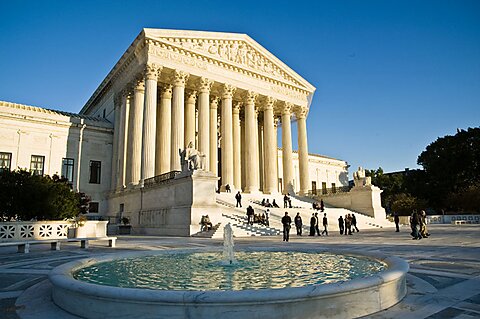
In today’s ruling in Cisco Systems Inc. v. Doe, the Supreme Court has written what may be a final chapter in the modern saga of the Alien Tort Statute (ATS), under which two generations of legal academics and advocates have sought to enlist the federal courts in remedying human rights violations outside the US through the medium of high-stakes litigation.
Today, writing for the Court, Justice Amy Coney Barrett rules that courts may not create new causes of action for violations of international norms under the ATS. Along the way, her opinion shoots down attempts to install “aiding and abetting” liability under the act—in general, when Congress wants to create that kind of liability, it says so. Overall, the decision may roll back the level and volume of future ATS litigation to what they were for most of US history, which is to say, not far from zero.
The Alien Tort Statute, enacted as part of the Judiciary Act of 1789, gives federal courts jurisdiction over cases brought by foreigners who allege a “violation of the law of nations or a treaty of the United States.” It aimed at assuring foreign governments that the United States would provide legal remedies for breaches of international law. Following a rapid expansion in the kinds of cases lower courts proved willing to hear in the 1980s and 1990s, the Court began whittling things back in decisions like Kiobel v. Royal Dutch Petroleum (2013) (presumption against liability for violations committed abroad) and Jesner v. Arab Bank, PLC (2018) (no suits against foreign corporations). Among its leading considerations was that imposing liability for behavior whose primary effects are abroad might interfere with sensitive US foreign policy objectives and that the Constitution entrusts Congress, not the judiciary, with the delicate balancing responsibility involved.
The ongoing rollback of implied ATS rights of action—which appears complete as of today—itself reflects one of the signal developments of the modern Court, the move toward disapproval of judicial creation of new rights of action in general. The key case here was Alexander v. Sandoval (2001). (I wrote a more pop-oriented critique of implied private rights of action not long before that.)
One of the Court’s cases during this transitional period was Sosa v. Alvarez-Machain (2004), in which it had indicated that it would leave the door open for some ATS claims at least, while urging “great caution” on lower courts. In a dissent for the three liberal Justices, Justice Sonia Sotomayor argues that the majority seems to be overriding Sosa without saying so and also without weighing the usual stare decisis factors, building on positions taken by conservative Justices earlier in dissent or concurrence.
These issues are all basically statutory, and a new Congress could, if it chose, craft new federal law creating or expanding rights to sue in this area. Indeed, it has done so at least once, in the Torture Victim Protection Act of 1991 (TVPA). A side issue in today’s case, incidentally, was whether the TVPA itself should be read as creating aiding-and-abetting liability. Only Sotomayor thought it did.
Like quite a number of decisions from the Court in recent years, today’s improves the coherence and predictable application of one sector of the law while leaving doubt as to which front to expect the next legal tremor and revamp of old law.